
Book Printing China by SunTop Printing
SunTop Printing specializes in custom and commercial book printing in China for publishers, companies, and institutions ordering paperback and other softcover books, as well as hardcover books. Larger book quantities use offset printing on coated or uncoated book papers, with vivid printed color and secure binding.
SunTop Printing completes printing and bookbinding in-house and holds G7 Master and ISO 12647 certifications. Offset press proofs and bulk offset printing use the same approved color targets. SunTop Printing’s all-in door-to-door ranges show delivered book cost, not printing price alone.

1998
Founded
50,000 m²
Printing Factory
50+
Printing Presses
10,000+
Customers Worldwide
Paperback and Hardcover Book Printing

Paperback and Softcover Books
SunTop Printing binds paperback and softcover books with flexible printed covers using perfect binding, including PUR adhesive binding.

Hardcover Books
Hardcover books use rigid cover boards, endpapers, and case binding around an adhesive-bound or Smyth-sewn book block.

Commercial Book Printing
SunTop Printing completes bulk paperback and hardcover book orders, including multiple titles and repeat orders.
How Much Does It Cost to Print a Book in China
Book printing in China commonly ranges from USD 1.60–6.20 per copy for paperback, hardcover, and offset book orders.
SunTop Printing calculates each book price from the trim size, page count, paper, cover, binding, quantity, and delivery destination.
Proofs and samples are included according to the book specification: a selected-page offset press proof, a cover proof, a bound structural sample, or a complete digitally printed and bound sample, with air courier delivery. Printed and bound books, export packing, sea freight, customs clearance, import duties, and final door-to-door delivery are also included, with no hidden charges.
Every price applies to one title, and all page counts refer to interior pages.
200 Page Paperback at 1000 Copies
SunTop Printing’s all-in door-to-door price for 1,000 copies of a 5.5 × 8.5 inch paperback with 200 black text interior pages delivered to the United States is USD 2.20–2.70 per copy. The paperback uses 80 gsm uncoated interior paper, a 250 gsm C2S cover printed in full color on the outside and finished with matte lamination, perfect binding, and offset printing.
The approval package includes a selected-page offset press proof on the interior paper, a finished cover proof on the final cover stock, a bound structural paperback sample, and air courier delivery.
The principal costs come from paper for the 200 interior pages, the folded signatures required by the page count, and perfect binding.
160 Page Paperback at 5000 Copies
For a 5,000-copy run delivered to Canada, SunTop Printing’s all-in door-to-door price for a 6 × 9 inch paperback with 160 black text interior pages is USD 1.60–1.80 per copy. The paperback uses 80 gsm uncoated interior paper, a 250 gsm C2S cover printed in full color on the outside and finished with gloss lamination, perfect binding, and offset printing.
Before bulk printing, SunTop Printing supplies a selected-page offset press proof on the interior paper, a finished cover proof on the final cover stock, and a bound structural paperback sample; all three are delivered by air courier.
Plate-making and press setup costs are spread across 5,000 copies of the same title.
200 Page Black Text Hardcover at 1000 Copies
A 1,000-copy 6 × 9 inch hardcover with 200 black text interior pages and delivery to the United States is priced by SunTop Printing at USD 3.20–3.80 per copy, all-in door-to-door. The book uses 80 gsm uncoated interior paper, an adhesive-bound book block, 120 gsm blank endpapers, 2.5 mm rigid cover boards, and case binding. Its 157 gsm C2S case wrap is offset printed in full color, matte laminated, and finished with a gold foil stamped front-cover title, screen-applied spot UV, and an embossed front-cover logo.
A selected-page offset press proof establishes the interior reference, while a separate cover proof confirms the printed case wrap and each finish position. The fully bound structural hardcover sample confirms the finished cover effects, endpapers, rigid case, spine, and final book structure; air courier delivery is included.
The foil stamping plate, spot UV screen, embossing die, and three separate finishing setups add fixed finishing costs to the hardcover order.
128 Page Full Color Hardcover at 1000 Copies
For the larger 8.5 × 11 inch format, SunTop Printing’s all-in door-to-door price for 1,000 hardcovers with 128 full color interior pages delivered to Australia is USD 4.90–5.80 per copy. The book uses 128 gsm gloss coated interior paper, an adhesive-bound book block, 120 gsm blank endpapers, 2.5 mm rigid cover boards, and case binding. Its interior pages and 157 gsm C2S case wrap are offset printed in full color, with gloss lamination on the case wrap.
For approval, SunTop Printing supplies a selected-page offset press proof on the gloss coated interior paper, a separate cover proof on the final case-wrap material, a fully bound structural hardcover sample, and air courier delivery.
The 8.5 × 11 inch trim and 128 full color coated pages increase sheet area and ink coverage, while rigid boards and case binding add hardcover materials and binding work.
200 Page Paperback at 100 Copies
At SunTop Printing’s 100-copy MOQ, a 5.5 × 8.5 inch paperback with 200 black text interior pages delivered to the United States costs USD 5.20–6.20 per copy, all-in door-to-door. The paperback uses 80 gsm uncoated interior paper, a 250 gsm C2S cover printed in full color on the outside and finished with matte lamination, perfect binding, and digital printing.
One complete digitally printed and bound sample is made with the selected 80 gsm uncoated interior paper, 250 gsm C2S cover stock, full color outside cover printing, matte lamination, and perfect binding; air courier delivery is included.
Digital printing avoids offset plates and press makeready, but bookbinding, the complete bound sample, air courier delivery, packing, and final door-to-door delivery are spread across only 100 books.

Perfect Bound Paperback
A flexible printed cover wraps the book block and forms the square spine.

Black Text on Uncoated Paper
Black text remains clear on the natural surface of uncoated book paper.

Hardcover Case and Endpapers
Endpapers connect the book block to the rigid case.

Full Color Coated Pages
Gloss coated paper gives full color pages a smooth reflective surface.
What Changes Book Printing Cost in China
Book Size
Book size affects how efficiently standard printing sheets are used. A smaller format is not always less expensive than a larger one with the same page count and quantity.
Page Count
More pages usually increase cost. For offset books, removing only a few pages may not reduce the number of sheets that must be printed and folded, so a small page reduction may not lower the price.
Interior Paper and Color
Interior paper grade, weight, coating, and the opacity needed to limit show-through change material cost. Black text or grayscale, selected color pages, and full color interiors are priced differently.
Cover Materials and Finishes
Cover cost changes with cover stock or case material, whether the inside cover is also printed, specified Pantone spot colors, lamination, and varnish. Hardcover cost also changes with board thickness.
Foil stamping, spot UV, embossing, and debossing must be quoted from the actual cover artwork, not from the finish name alone.
Bookbinding
Binding cost depends on both the book block and the cover structure. For softcover books, perfect-binding cost changes when PUR adhesive is specified.
For hardcovers, adhesive-bound and Smyth-sewn book blocks are priced differently even when the hardcover case specification is the same.
MOQ and Order Quantity
SunTop Printing’s book printing MOQ is 100 copies. Printing method depends on the book specification and quantity: digital printing can serve lower quantities, while offset cost per copy generally falls as copies per title increase.
In offset printing, each title requires its own press setup, so unit cost depends on the quantity of each title rather than the combined number of books.
Why Book Printing Quotes Differ
Two all-in book printing quotes are comparable only when the book specifications, printing method, and final delivery basis match.
A lower unit price does not necessarily mean the same book order costs less. It may reflect different specifications, a different number of titles, a different quantity per title, or a different final delivery basis.
Trim Size and Page Count
Confirm that both quotes use the same trim size and count pages the same way. A quote for 200 interior pages plus a cover is not the same as a quote for 200 pages including the cover.
Paper Grade, Shade, and Interior Color
Compare the interior paper grade, weight, shade, and whether it is coated or uncoated. Then confirm whether the interior is black text or grayscale, includes selected color pages, or is full color.
When selected color pages are included, the quoted number of color pages must also match. Matching paper weight alone does not make two quotes equivalent.
Cover Printing, Finishes, and Book Structure
For softcover books, compare the cover stock, whether the cover is printed on the outside only or on both the outside and inside, specified spot colors, cover finish, and the adhesive specified for perfect binding, including whether PUR is required.
For hardcovers, compare board thickness, case material, endpapers, whether the book block is adhesive-bound or Smyth-sewn, case binding, and cover finish. Two hardcovers can look similar from the outside while using different book blocks or endpapers.
Title Count, Proofs, and Delivered Cost
Start with the quantity for each title and the type and number of proofs and samples included.
An order for 5,000 copies of one title is not the same as ten titles at 500 copies each.
A selected-page offset press proof, a cover proof, and a bound structural sample provide separate references for interior printing on the selected paper, cover printing and specified finish positions, and bound structure. They are not interchangeable.
Compare sea freight and final delivery to the same destination using the same export packing method and the same carton or pallet basis. Confirm that customs clearance and import duties are included in both quotes.
Compare delivered book cost, not printing price alone.
Book Printing Quality from Color to Binding

Vivid Printed Color
Covers and interior pages reproduce vivid CMYK illustrations, graphics, and full color content, with Pantone spot colors used where specified. Color remains consistent from cover to interior and across the ordered quantity.

Coated and Uncoated Book Papers
Coated paper presents printed color on a smoother surface, while uncoated paper leaves more of the paper shade and texture visible. Higher paper opacity reduces show-through from printing on the reverse side.

Book Covers and Finishes
Lamination adds a protective film to the printed cover, while varnish adds a protective coating to the printed surface. Foil stamping adds metallic detail, spot UV adds gloss contrast to selected cover areas, and embossing and debossing create raised or recessed cover elements.

Secure Pages and Aligned Covers
Pages remain securely bound and spines stay straight. In Smyth-sewn books, folded sections are stitched through the fold to keep the book block secure. On hardcover books, the rigid case aligns squarely with the book block, and the endpapers are evenly positioned inside the covers.


28+
Years
Printing
How SunTop Verifies Book Printing Quality
SunTop Printing completes offset press proofs, bulk offset printing, and bookbinding in-house at its Shenzhen printing factory. SunTop Printing uses Heidelberg Speedmaster presses, including XL 162 and XL 145 models, for offset press proofs and bulk offset printing. SunTop Printing holds G7 Master and ISO 12647 certifications. G7 gray balance and tonality targets and ISO 12647 CMYK offset printing parameters are applied to both the approved offset press proof and the bulk run. Specified brand colors are matched with Pantone spot colors.
During printing, inline spectral measurement compares printed sheets with the approved color target using CIELAB measurements. Delta E ≤ 1.0 batch color control quantifies the color difference from that target, and 100% inline inspection checks every printed sheet for printing defects.
SunTop Printing completes PUR perfect binding on the Müller Martini Acoro A7 and perfect binding on the Müller Martini Corona C15. The Meccanotecnica asterPRO sews folded signatures into Smyth-sewn book blocks, and the KOLBUS BF520 completes hardcover case binding.
For repeat orders, SunTop Printing retains the approved color targets, recorded CIELAB values, paper and cover finish specifications, and printing and bookbinding records. Bound structural samples provide the reference for binding and final book structure, while retained book samples provide a physical reference from the previous printed and bound order.
For book orders using certified paper, SunTop Printing’s FSC Chain of Custody certification supports traceable FSC-certified paper sourcing and FSC claims. Before shipment, every printed and bound book undergoes 100% final inspection for printed color, page sequence, trimming, cover finish, binding security, endpapers, and hardcover case fit.
CIELAB Measurements
Delta E ≤ 1.0 Batch Color
100% Inline Inspection
100% Final Inspection
Book Printing China Questions
Book printing in China commonly ranges from USD 1.60–6.20 per copy for paperback, hardcover, and offset book orders.
SunTop Printing’s listed book prices include the corresponding offset press proof, cover proof, bound structural sample, or digitally printed and bound sample, together with air courier delivery, printed and bound books, export packing, sea freight, customs clearance, import duties, and final door-to-door delivery, with no hidden charges.
Trim size, page count, paper, color, cover, binding, quantity, printing method, packing, and destination change book printing cost.
SunTop Printing’s book printing MOQ is 100 copies for paperback, softcover, and hardcover books. Book size, page count, paper, color, cover, binding, and order quantity determine the printing method. More offset copies share the plate and press setup, reducing setup cost per copy.
Book printing quotes are comparable only when they cover the same book specifications, title count, quantity per title, printing method, proofs and samples, export packing, shipping method, customs clearance, import duties, and final delivery destination.
SunTop Printing manufactures paperback, softcover, and hardcover books in-house, completing offset printing, perfect binding, Smyth sewing, and case binding at its Shenzhen printing factory. SunTop Printing holds G7 Master and ISO 12647 certifications, matches specified brand colors with Pantone spot colors, and uses CIELAB measurements, Delta E ≤ 1.0 batch color control, and 100% inline inspection during bulk printing.
Offset press proofs establish the printed color reference, bound structural samples confirm the final book structure, retained book samples support repeat orders, and 100% final inspection covers every printed and bound book before shipment.

Request a Book Printing Quote
Send the book details you have, plus the delivery country or region, city, and postal code. A short description is enough to begin an all-in door-to-door quote.
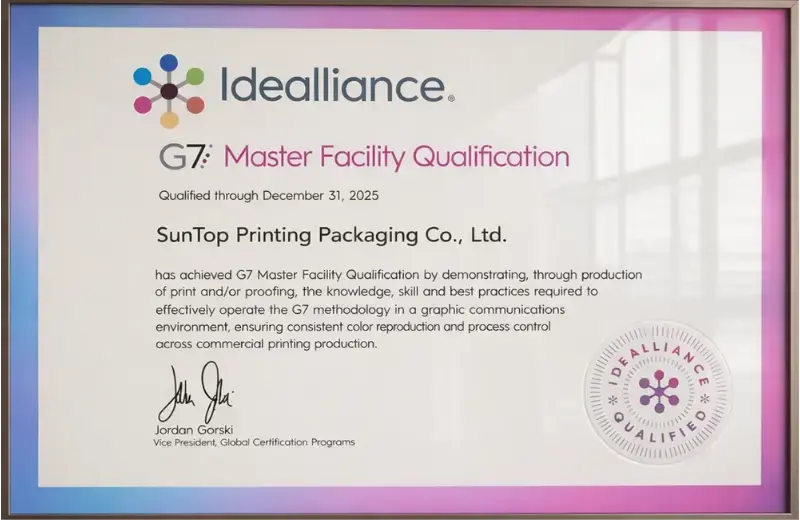
G7 Master Certification
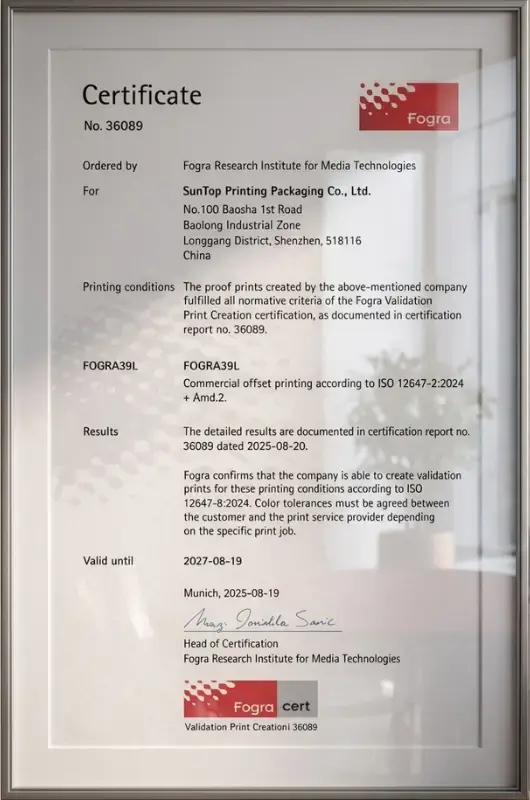
ISO 12647 Certification
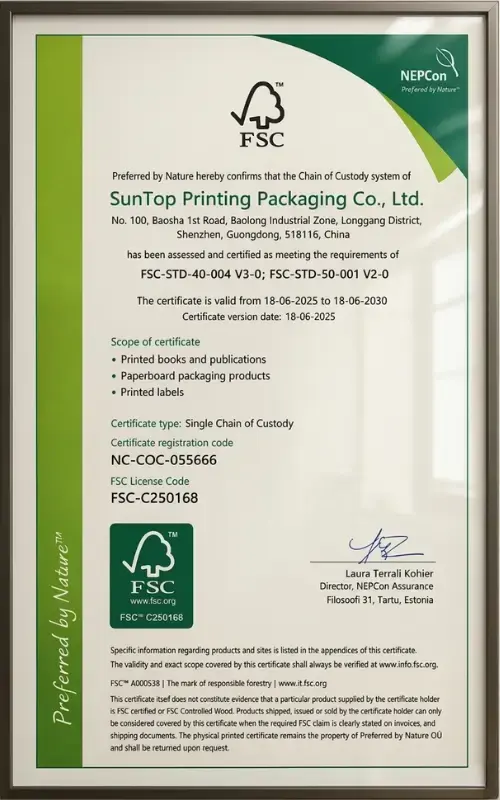
FSC Chain of Custody Certification