
Home / Packaging Boxes / Packaging Box Cost
Packaging Box Cost
Packaging Box Cost for Custom Printed Folding Cartons
For China custom printed folding carton projects, SunTop Printing reviews packaging box cost around MOQ, order quantity, finished size, dieline size, paperboard, box style, packaging color, Pantone or white ink requirements, finishes, dies, creasing, folding-gluing, packing volume, delivery country, and order terms.
Packaging box cost should not be compared by unit price alone. The same finished box can be priced differently when finished size, flat dieline, paperboard, box style, packaging color, finishes, die tooling, folding-gluing, packing volume, or order terms change.
SunTop Printing bases each box price on the carton specification, production quantity, and order terms used for a custom printed paperboard or cardstock folding carton quote.

1998
Founded
50,000 m²
Manufacturing Facility
50+
Printing Presses
10,000+
Customers Worldwide
How Much Do Packaging Boxes Cost?
Packaging box cost for custom printed paperboard and cardstock folding cartons is usually reviewed first as a production price per finished box.
For commercial runs around 5,000–20,000 pcs, a meaningful price needs a known finished size, paperboard grade, print coverage, box structure, die complexity, and proof or sample requirement.
Base Cardstock and Standard Retail Cartons
Base cardstock and standard retail cartons often fall around USD 0.18–0.55 per box.
A common USD 0.18–0.55 case is a small or medium retail folding carton with main visible panels around 60–150 mm, 300–350 gsm SBS, C1S, FBB, white card, or similar paperboard, one-side CMYK printing or limited spot color, straight tuck or reverse tuck structure, standard die-cutting, and normal proof or sample review.
Larger panels, thicker paperboard, inside printing, multiple Pantone colors, window film, specialty paperboard, heavier finish area, non-standard die complexity, or quantities below common commercial runs can move the price higher.
Custom Brand and Multi-SKU Product Boxes
Custom brand and multi-SKU product boxes often fall around USD 0.28–0.95 per box.
A typical USD 0.28–0.95 project includes a related product-box family, not only one repeated carton size. Projects often use 300–400 gsm SBS, C1S, FBB, white-back paperboard, or similar cardstock, related box sizes, related dielines, CMYK printing, Pantone targets, solid brand color areas, optional inside printing, shared finish requirements, and repeat-order planning.
Price moves higher when SKU quantities split the order, artwork versions require separate handling, color targets differ by SKU, dielines cannot share tooling logic, finish requirements change between versions, or separate dies and separate proofs are needed.
Cosmetic, Beauty, and Supplement Boxes
Cosmetic, beauty, and supplement boxes often fall around USD 0.42–1.65 per box.
A typical USD 0.42–1.65 project is a small or medium skincare, makeup, fragrance, vitamin, supplement, or nutraceutical folding carton with visible panels around 40–180 mm, 350–400 gsm SBS, C1S, FBB, metallic paperboard, or specialty paperboard. The price often changes with Pantone targets, white ink, solid coverage, metallic-board color adjustment, material appearance, finish position after folding, sample approval, and batch consistency.
Larger finish areas, foil or UV requirements, embossing or debossing, multi-SKU versions, repeat-order consistency, and approved-sample matching can raise the box price. Luxury cosmetic cartons or heavier finish combinations can move above this range.
Eco Board and Premium Finish Boxes
Eco board cartons often fall around USD 0.35–0.90 per box. Premium finish folding cartons often fall around USD 0.65–2.20+ per box.
Eco board pricing usually reflects FSC, recycled, recyclable, kraft, uncoated, or high-density paperboard choices, often around 300–400 gsm in common folding-carton projects. Board shade, recycled fiber behavior, stiffness, crease response, printed appearance, and folded shape can affect production.
Premium finish pricing usually reflects finish area, added dies, finish sample review, and order quantity. Foil, UV, lamination, embossing, or debossing can raise the box unit price when placement, area, or folded-surface alignment becomes demanding.

MOQ and Bulk Price
Higher quantities spread setup cost across more boxes.

Dieline and Paperboard
Dieline size, board grade, and stiffness shape the base box price.

Packaging Color and White Ink
Pantone targets, solid color areas, inside printing, and white ink can raise the box price.

Finishes, Dies, and Unit Price
Finish area, added dies, and order quantity can change the box unit price.
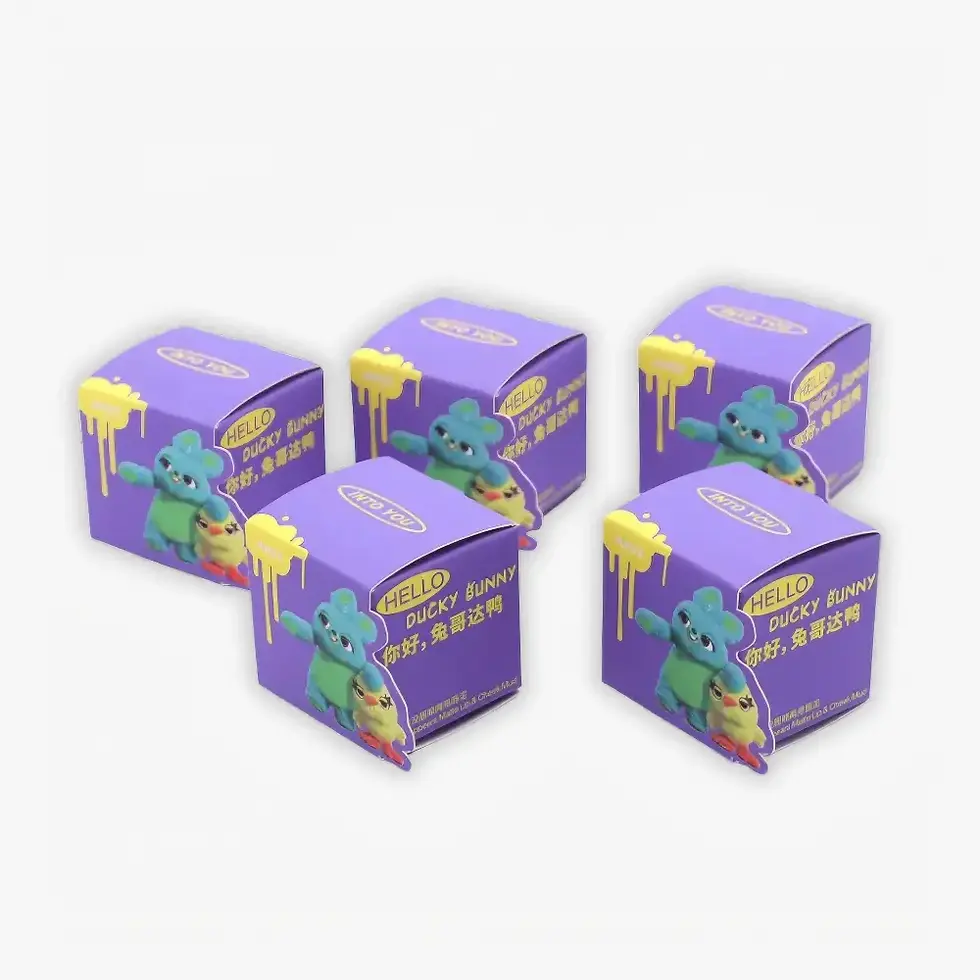
Why Order Quantity Changes the Box Price
Order quantity changes the packaging box unit price because printing, die-cutting, creasing, folding-gluing, proofing, and make-ready work must be prepared before finished cartons are produced. When the order is small, preparation cost is divided across fewer boxes, so MOQ keeps the carton order practical for material purchasing, press setup, tooling, and inspection.
Bulk packaging box orders usually reduce the per-box price because more finished cartons share the preparation work. Even when carton size, paperboard, printing, and box style stay the same, a larger run can spread setup, tooling, and proofing across more boxes.
Printing plates, cutting dies, setup time, samples, proofs, and make-ready waste do not rise in a straight line with every box produced. For the same carton, a small quantity can carry a much higher unit price, while a bulk quantity can carry a lower unit price.
Box Size, Dieline, Paperboard, and Box Style
Packaging box cost starts with the finished box size and the flat dieline used to produce the carton. A larger unfolded layout, heavier paperboard, less efficient sheet use, window area, crease setup, or folding-gluing requirement can change how the carton is printed, die-cut, creased, folded, glued, and priced.

Finished Size, Dieline, and Paperboard
A packaging box is usually described by finished length, width, and height. Pricing also depends on the unfolded dieline, sheet layout, die shape, board use, and paperboard waste required to make that finished size.
Paperboard grade sets the material basis for the carton. Common choices include SBS, FBB, C1S, CCNB, white-back paperboard, kraft paperboard, recycled paperboard, FSC-certified paperboard, metallic paperboard, and specialty paperboard. Thickness, stiffness, surface, grain direction, and folding response can differ even when two boards look similar at first review.
A larger unfolded dieline, heavier board, stricter stiffness requirement, less efficient sheet layout, or higher paperboard waste can raise the folding carton cost even when the finished box looks simple.
Box Style, Window, Creasing, and Folding-Gluing
Box style changes the dieline, closure structure, and forming work required for the carton. Straight tuck end boxes, reverse tuck end boxes, tuck boxes, auto-lock bottom boxes, locking structures, and window boxes can require different die tooling, crease positions, folding paths, closure fit, and glued seam placement.
Window size, PET or PVC film area, complex locking tabs, auto-lock bottom structure, larger glue flaps, and tighter closure fit can make two visually similar boxes carry different folding carton costs.
Creasing and folding-gluing also affect the quote because a flat printed sheet has to close cleanly and hold its shape after forming. Board stiffness, crease depth, folding rebound, lock position, and glued seam position all affect the finished carton and the box price.

Packaging Color and Finishes That Change Price
Packaging color and finishing requirements can change the box unit price even when the size, paperboard, and box style stay the same. A color target, heavy ink coverage, white ink, metallic board, larger finish area, added die, or finish position after folding can change the way the carton is produced and priced.
CMYK, Pantone, White Ink, and Print Coverage
CMYK printing is usually the base choice for custom printed paperboard and cardstock folding cartons. Price can move higher when artwork uses heavy ink coverage, large solid color areas, inside and outside printing, multiple Pantone or spot colors, or stricter brand-color requirements.
Pantone and spot colors can add cost because ink preparation, press setup, and approval expectations become more specific than standard CMYK printing. White ink can also change price when metallic paperboard, kraft paperboard, colored paperboard, or specialty paperboard needs a stronger printed base before the visible color is applied.
A simple retail carton with one-side CMYK printing is easier to price than a carton with full-surface color, inside printing, Pantone targets, spot colors, white ink, or color-critical artwork versions.
Foil, UV, Lamination, Embossing, and Finish Area
Finishes change the box unit price through finish type, finish area, added dies, approval needs, and finish alignment requirements. Foil stamping, spot UV, lamination, embossing, and debossing can be priced very differently when the finish area, position, and number of finished panels change.
A small logo foil area is not priced the same as a large foil panel. A small UV highlight is not priced the same as a large UV surface. Embossing or debossing across a logo, panel, or folded edge can require different dies and different finish setup.
Finish position after folding also matters. A finish that crosses a crease line, meets a closure panel, sits near a glued seam, or must align across multiple panels can add die work, setup time, and finish-position control, which can raise the box unit price.
Box Price and Total Order Price
Box unit price is the production price for one finished folding carton. Total order price combines the box unit price, order quantity, shipped-flat packing, packed volume, weight, pallet or container basis, delivery country, shipping method, destination requirements, and order terms.
Paperboard and cardstock folding cartons are usually shipped flat before product filling. Shipped-flat cartons can improve packing density, but the packed order still depends on finished box size, folded carton thickness, outer carton count, gross weight, dimensional weight, and pallet or container basis.
For international packaging box orders, a useful cost comparison reads the box unit price together with packed volume, weight, delivery country, shipping method, destination requirements, and order terms.


Why Packaging Box Quotes Differ
Packaging box quotes differ when two prices do not describe the same finished folding carton. Two packaging box quotes are only comparable when they describe the same finished carton requirement and include the same quoted items.
The first difference is often hidden in the structure. The outside box size may look the same, while the flat dieline, glue flap, lock structure, window opening, display panel, die shape, sheet layout, or board use can change the actual folding carton being priced.
Paperboard wording can also make two quotes look closer than they are. A comparable quote should name the board grade, thickness or caliper, stiffness, surface, and folding response. White card, paperboard, or cardstock alone may not describe the same material level as SBS, FBB, C1S, CCNB, white-back paperboard, kraft paperboard, recycled paperboard, FSC-certified paperboard, metallic paperboard, or specialty paperboard.
Packaging color and finish details need the same clarity. CMYK-only printing, Pantone or spot colors, white ink, metallic board adjustment, inside printing, UV, lamination, foil, embossing, debossing, finish area, finish position, added dies, proofs, and approval needs can change what the quoted box price includes.
The formed carton requirement is the final comparison point. Folding-gluing setup, closure fit, glued seam position, window application, finished-carton checking, dies, samples, proofs, delivery basis, order terms, and other included costs should be visible before two box prices are judged side by side. A stronger packaging box quote makes the same carton requirement and the same included items clear, instead of showing only a lower unit price.
Reliable Packaging Box Pricing from SunTop Printing
Reliable packaging box pricing from SunTop Printing is tied to the carton that will actually be produced: printed color, finish position, dieline, creasing, folding-gluing, formed-carton checking, and repeat-order reference.
For custom printed paperboard and cardstock folding cartons, SunTop reviews packaging box pricing inside the same Shenzhen manufacturing base that handles printing preparation, packaging color control, surface finishing, die-cutting, creasing, folding-gluing, finished-carton checking, and repeat-order records.


28+
Years
Printing
In-House Printing, Packaging Color, and Finish Control
SunTop’s in-house printing connects CMYK artwork, Pantone colors, white ink, metallic paperboard, UV printing, foil stamping, lamination, and other finish requirements with the finished printed carton result used for pricing.
G7 Master color management, ISO 12647 printing standard, Pantone color control, Heidelberg CTP, and Heidelberg Speedmaster XL 162 and XL 145 multi-color offset presses support the printed-color and finish requirements used in packaging box pricing.
For color-sensitive folding carton orders, closed-loop spectrophotometer checking, Lab value records, and Delta-E records connect the approved color target with the finished printed carton result.
Dies, Creasing, Folding-Gluing, and Repeat Order Records
Reliable pricing also depends on how the flat printed sheet becomes a formed folding carton. Die-cutting dies, crease rules, creasing matrix, folding-gluing setup, closure fit, and glued seam position define whether the quoted carton can be formed, closed, glued, and packed as required.
Where the carton structure requires tighter forming control, glued seam positioning tolerance within ±0.5mm, formed carton shape, closure behavior, and automatic cartoning line stability are checked against the intended packing use.
Finished-carton checking, outgoing inspection, production log data recall, and production retain sample comparison give repeat packaging box orders a clearer reference. Repeat pricing can be checked against prior production records and retained samples instead of being rebuilt from loose specifications.

Packaging Box Cost Questions
How much do packaging boxes cost?
Packaging boxes for custom printed paperboard and cardstock folding cartons often range from USD 0.18–2.20+ per box for commercial runs around 5,000–20,000 pcs. Common planning ranges are USD 0.18–0.55 for base cardstock retail cartons, USD 0.28–0.95 for custom brand and multi-SKU boxes, USD 0.42–1.65 for cosmetic, beauty, and supplement boxes, USD 0.35–0.90 for eco board cartons, and USD 0.65–2.20+ for premium finish folding cartons.
These ranges are production price per finished box, not fixed catalog prices or final total order prices. Finished size, flat dieline, paperboard grade, box structure, print coverage, finish requirement, dies, and quantity must describe the same folding carton before prices are compared.
Why does order quantity change packaging box price?
Order quantity changes packaging box price because printing plates, cutting dies, setup time, samples, proofs, and make-ready waste are prepared before finished cartons are produced. Small orders spread this preparation across fewer boxes, so the unit price is usually higher.
Bulk orders spread the same preparation across more cartons, usually lowering the per-box price. MOQ helps keep paperboard purchasing, press setup, die-cutting, creasing, folding-gluing, and finished box inspection practical.
What changes custom folding carton cost?
Custom folding carton cost changes with finished box size, flat dieline size, sheet layout, paperboard grade, board thickness, stiffness, box style, window structure, creasing, and folding-gluing requirements.
A larger flat layout, wider glue flap, lock structure, window opening, different die shape, heavier paperboard, or more demanding folding-gluing requirement can change the price even when folded boxes look similar. SBS, FBB, C1S, CCNB, white-back paperboard, kraft paperboard, recycled paperboard, FSC-certified paperboard, metallic paperboard, and specialty paperboard can price differently because thickness, stiffness, surface, crease response, and forming behavior are not the same.
How do packaging colors and premium finishes affect custom box pricing?
Packaging colors and premium finishes affect custom box pricing by changing print preparation, ink setup, finish work, added dies, approval needs, and finish-position control.
CMYK, Pantone colors, spot colors, white ink, metallic board, heavy ink coverage, inside printing, UV, foil, spot UV, lamination, embossing, debossing, finish area, finish position, and added dies can raise the box unit price. A small foil logo, large foil panel, small UV highlight, large UV surface, or embossed detail across a folded edge can each create a different pricing basis.
How do shipped-flat cartons, packing volume, and delivery country affect total order price?
Box unit price is the production price for one finished folding carton. Total order price also reflects shipped-flat packing, packed volume, weight, delivery country, shipping method, destination requirements, and order terms.
Paperboard and cardstock folding cartons are usually shipped flat before filling. Outer carton count, gross weight, dimensional weight, pallet or container basis, delivery country, and order terms can change the final total, so a lower box unit price is not always the lower total order price.
Why do packaging box quotes differ and how does SunTop support reliable pricing?
Packaging box quotes differ when two prices do not describe the same finished folding carton or the same included items. A comparable quote should make finished size, flat dieline, paperboard grade, packaging color, finish details, formed-box requirements, dies, samples, proofs, delivery basis, order terms, and included costs clear.
SunTop supports reliable packaging box pricing with in-house color control, G7 Master color management, ISO 12647 printing standard, Pantone color control where required, die and creasing review, folding-gluing control, formed-carton checking, production records, and retained sample comparison. For repeat orders, records and retained samples connect printed color, finish position, folded size, formed box size, lock position, and glued seam position with the approved prior order.
Request a Packaging Box Quote
Send the packaging box details you already have. A short description is enough to start.
Available details may include size, quantity, box style, paperboard preference, packaging color or Pantone requirement, finish requirement, delivery country, and artwork or dieline status.

G7 Master Color Management
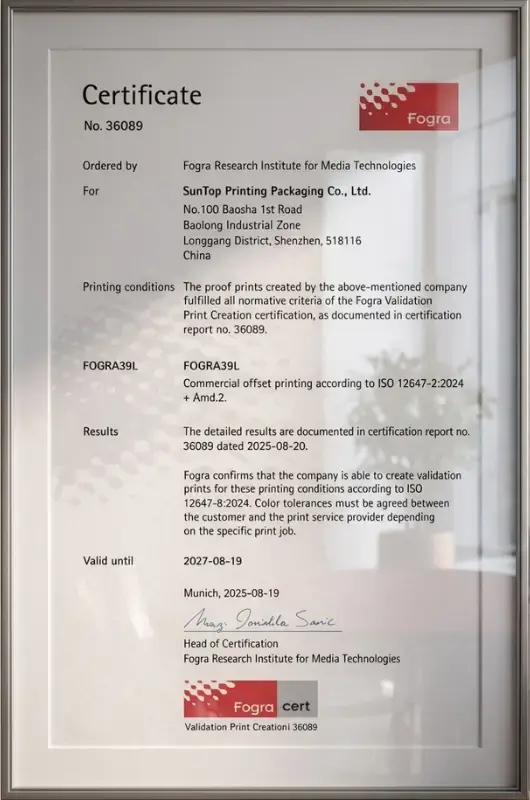
ISO 12647 Printing Standard
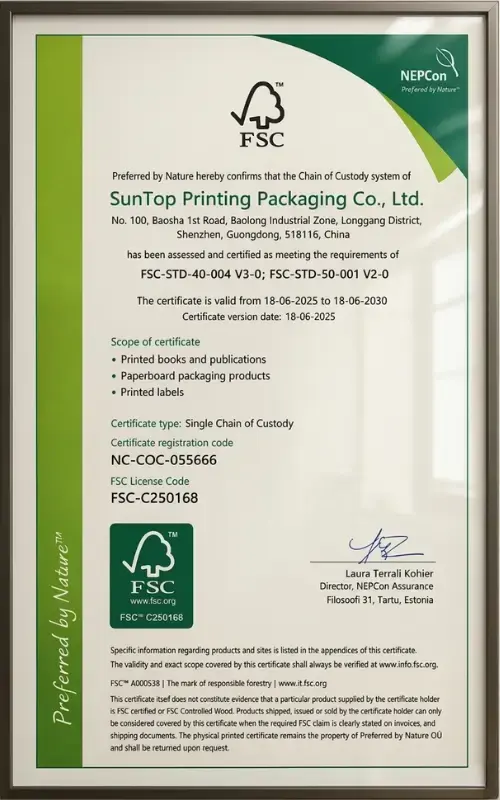
FSC-Certified Paper Options